
Wednesday, June 27, 2007


Tuesday, June 26, 2007

Sunday, June 24, 2007

Friday, June 22, 2007
Ramliah & Bandung Cleft Center
Ramliah, girl, 14 years old, was successfully operated (cleft lip) by Prof. Sunardi Mangundjaja in Hasan Sadikin Hospital, Bandung on Wednesday, 20 June 2007. Ramliah accompanied from Makassar to Bandung by Mr. Achmad Mochtar & Mrs. Monika Mochtarova (Bonn), Mr. Ikhsan Kenni, Mrs. Dewi (Pare-pare), Mrs. Sutini (Bandung) and her mother.
Drg. Ruslin and Drg. Andi Tajrin (Residents of Oral Surgery Department, Dentistry Faculty, Padjadjaran University Bandung are both from Makassar) prepared everything for Ramliah from first examination, diagnosed, pre-operation preparation, during operation until post-operation management.
I will post Ramliah post-operative picture on my next blog-report.
On Thursday, 21 June 2007, I and Mr. Achmad Mochtar, Mrs. Monika Mochtarova, Mr. Ikhsan Kenni, Mrs. Dewi, Mrs. Sutini and Drg. Tajrin visited Bandung Celft Center and met Prof. Tet Soeparwadi (Chairperson). Prof. Tet explained the activities and marvelous achievements of Bandung Cleft Center. We really amaze with their humanitarian work for decades.
I quote some important points from the Annual Report 2006:
Yayasan Pembina Penderita Celah Bibir dan Langit-langit (YPPCBL) or Support for Cleft Lip and Palate Patients Foundation is a non-profit social organization that aims mainly to provide services for cleft lip and palate patients with economic disadvantages. Initiated by Prof. drg. Soeria Soemantri, MPH, the foundation was established on June 25, 1979. Today, the foundationis a legal entity, certified under a Notary Act No. 35, issued on June 25, 1979 by Harry Hardjito, Notary Public.
Initially, YPPCBL performed its social activities in Taman Lalu Lintas Ade Irma Suryani (a children playground). In 1984 YPPBCL rented a residential building, 8 Eyckman Street, which then become its secretariat. In 1994 n 1994 YPPCBL owned its own building in Pelesiran Street Bandung. In the new building YPPCBL was able to develop its activities. The building served not only as the foundation’s administration center, but also as a temporary accommodation for inpatients from outside Bandung who were waiting for their surgery or were under post operative treatment.
In early 2006, with a donation from the Japanese Government, YPPCBL began the construction of Cleft Center Building on 1 Sekeloa Selatan Street, Bandung. Padjadjaran University Bandung, especially the Faculty of Dentistry, also supported the project by providing a 275 m2 land area for the building. With a new Cleft Center Building, officially opened on May 26, 2007, YPPCBL is expected to be more committed to improving its service network to more Indonesian people, especially those with economic disadvantages.
In general, it is impossible for YPPCBL TO run its activities and missions without consistent help from its management board, staff, and donors.
Board of Management
Chairperson: Prof. drg. Tet Soeparwadi, SpBM
Vice Chairperson I: drg. Ida Ayu Astuti, SpBM
Vice Chairperson II: Prof. DR. Eky S. Soeria Soemantri, drg, SpOrt.
Medical Activities 2006
In 2006, YPPCBL received cleft lip and palate surgery requests from 1,033 economically disadvantaged patients, of whom 974 were new patients and 59 were second-surgery patients. Of the total number patients, 1,015 have undergone surgery, while 18 patients did not continue their treatment due to various reasons.
The surgeries that have been performed in social service events outside Bandung are in Tulang Bawang, Tarutung, Mataram, Karangasem, Malang, Bondowoso, Pandeglang, Balige, Bogor, Tasikmalaya, Makassar, Ketapang, Kuningan.
The types of surgeries performed are: Cleft palate (270), cleft lip (768), lip reconstruction(12), palate reconstruction (8), gnathic reconstruction (2), facial cleft (2), bonegraft (4), cheiloplasty (1), nose reconstruction (1).
From 1979 to 2006 YPPCBL has helped 8,454 patients.
Cooperation
RENA Foundation
Smile Train, US
Japanese Government
Help Indonesia Children
Rotary Club of Jakarta Metropolitan
PT Gajah Tunggal, Tbk
2007 WORK PLAN
1. Increase the number of patients treated
2. Organize social charity events in a number of regions in West Java: Tasikmalaya, Serang, Sukabumi, Cilacap, Bogor and Serang.
3. Organize social charity events in a number of regions outside West Java: Mataram, Sintang, Medan, Bondowoso, Ambon, Situbondo, Sumenep, Batu, Pare-pare and Kupang.
4. Provide more surgical equipment for Cleft Center
5. Provide counseling and organize dissemination on cleft lip and palate treatment and prevention.
6. Improve the quality of its oral surgery specialists.
If you or your organization/network would like to support, please contact:
Yayasan Pembina Penderita Celah Bibir dan Langit-Langit (YPPCBL)
Indonesian Cleft Lip & Palate Foundation
Gedung Cleft Center
Komp. FKG Unpad
Jalan Sekeloa Selatan No. 1, Bandung 40132- Indonesia
Phone: +62 22 2533081, +62 22 70704696
Fax: +62 22 2533081
Account Number: 024-01-31428-006 Niaga Bank
Drg. Ruslin and Drg. Andi Tajrin (Residents of Oral Surgery Department, Dentistry Faculty, Padjadjaran University Bandung are both from Makassar) prepared everything for Ramliah from first examination, diagnosed, pre-operation preparation, during operation until post-operation management.
I will post Ramliah post-operative picture on my next blog-report.
On Thursday, 21 June 2007, I and Mr. Achmad Mochtar, Mrs. Monika Mochtarova, Mr. Ikhsan Kenni, Mrs. Dewi, Mrs. Sutini and Drg. Tajrin visited Bandung Celft Center and met Prof. Tet Soeparwadi (Chairperson). Prof. Tet explained the activities and marvelous achievements of Bandung Cleft Center. We really amaze with their humanitarian work for decades.
I quote some important points from the Annual Report 2006:
Yayasan Pembina Penderita Celah Bibir dan Langit-langit (YPPCBL) or Support for Cleft Lip and Palate Patients Foundation is a non-profit social organization that aims mainly to provide services for cleft lip and palate patients with economic disadvantages. Initiated by Prof. drg. Soeria Soemantri, MPH, the foundation was established on June 25, 1979. Today, the foundationis a legal entity, certified under a Notary Act No. 35, issued on June 25, 1979 by Harry Hardjito, Notary Public.
Initially, YPPCBL performed its social activities in Taman Lalu Lintas Ade Irma Suryani (a children playground). In 1984 YPPBCL rented a residential building, 8 Eyckman Street, which then become its secretariat. In 1994 n 1994 YPPCBL owned its own building in Pelesiran Street Bandung. In the new building YPPCBL was able to develop its activities. The building served not only as the foundation’s administration center, but also as a temporary accommodation for inpatients from outside Bandung who were waiting for their surgery or were under post operative treatment.
In early 2006, with a donation from the Japanese Government, YPPCBL began the construction of Cleft Center Building on 1 Sekeloa Selatan Street, Bandung. Padjadjaran University Bandung, especially the Faculty of Dentistry, also supported the project by providing a 275 m2 land area for the building. With a new Cleft Center Building, officially opened on May 26, 2007, YPPCBL is expected to be more committed to improving its service network to more Indonesian people, especially those with economic disadvantages.
In general, it is impossible for YPPCBL TO run its activities and missions without consistent help from its management board, staff, and donors.
Board of Management
Chairperson: Prof. drg. Tet Soeparwadi, SpBM
Vice Chairperson I: drg. Ida Ayu Astuti, SpBM
Vice Chairperson II: Prof. DR. Eky S. Soeria Soemantri, drg, SpOrt.
Medical Activities 2006
In 2006, YPPCBL received cleft lip and palate surgery requests from 1,033 economically disadvantaged patients, of whom 974 were new patients and 59 were second-surgery patients. Of the total number patients, 1,015 have undergone surgery, while 18 patients did not continue their treatment due to various reasons.
The surgeries that have been performed in social service events outside Bandung are in Tulang Bawang, Tarutung, Mataram, Karangasem, Malang, Bondowoso, Pandeglang, Balige, Bogor, Tasikmalaya, Makassar, Ketapang, Kuningan.
The types of surgeries performed are: Cleft palate (270), cleft lip (768), lip reconstruction(12), palate reconstruction (8), gnathic reconstruction (2), facial cleft (2), bonegraft (4), cheiloplasty (1), nose reconstruction (1).
From 1979 to 2006 YPPCBL has helped 8,454 patients.
Cooperation
RENA Foundation
Smile Train, US
Japanese Government
Help Indonesia Children
Rotary Club of Jakarta Metropolitan
PT Gajah Tunggal, Tbk
2007 WORK PLAN
1. Increase the number of patients treated
2. Organize social charity events in a number of regions in West Java: Tasikmalaya, Serang, Sukabumi, Cilacap, Bogor and Serang.
3. Organize social charity events in a number of regions outside West Java: Mataram, Sintang, Medan, Bondowoso, Ambon, Situbondo, Sumenep, Batu, Pare-pare and Kupang.
4. Provide more surgical equipment for Cleft Center
5. Provide counseling and organize dissemination on cleft lip and palate treatment and prevention.
6. Improve the quality of its oral surgery specialists.
If you or your organization/network would like to support, please contact:
Yayasan Pembina Penderita Celah Bibir dan Langit-Langit (YPPCBL)
Indonesian Cleft Lip & Palate Foundation
Gedung Cleft Center
Komp. FKG Unpad
Jalan Sekeloa Selatan No. 1, Bandung 40132- Indonesia
Phone: +62 22 2533081, +62 22 70704696
Fax: +62 22 2533081
Account Number: 024-01-31428-006 Niaga Bank
Sunday, June 17, 2007
DELFAMI - a low cost, 20% protein snack
 We have developed a low cost high protein (20%) snack, ideal for kids additional food, malnourished children, humanitarian program, disaster program, government additional food program, school food program and many others.
Just eat or pour with warm water!
One pack (50 grams with 10 gram protein): IDR 1,600 excluding tax. Further information and purchase contact me at kadar@bdg.centrin.net.id
Entrepreneurship in Health Profession
Al-Islam Polytechnic School, Bandung in association with Imani Relief (Islamic Medical Association) West Java, Dompet Dhuafa Bandung (‘The Poor Purse” humanitarian organization), PT Pandu Persada Hospital Planner Consultant, Islamic Hospital Consortium, Al-Islam Hospital Bandung, Amanah Cooperative will run a seminar for health professionals in Bandung on Saturday, July 21, 2007, venue: Auditorium of Al-Islam Hospital, Jalan Soekarno-Hatta No. 644, Floor 6, Bandung, the title: ENTREPENERSHIP IN HEALTH PROFESSION.
Several individuals will present their papers and discuss it amongst participants and share an idea to enrich their health professional life through entrepreneurship behavior. Papers will be offered by Dr. Budi Setiawan, Mr. Catur M. Dria, Mr. Haris, Mrs. Hj. Siti Rohayah and myself.
Dr. Budi Setiawan specifically will present a highlight on Bandung maternal mortality, based on his work on the cooperation between Bandung NGOs and USAID.
Come and join us!
Several individuals will present their papers and discuss it amongst participants and share an idea to enrich their health professional life through entrepreneurship behavior. Papers will be offered by Dr. Budi Setiawan, Mr. Catur M. Dria, Mr. Haris, Mrs. Hj. Siti Rohayah and myself.
Dr. Budi Setiawan specifically will present a highlight on Bandung maternal mortality, based on his work on the cooperation between Bandung NGOs and USAID.
Come and join us!
Sunday, June 10, 2007

Saturday, May 19, 2007

Thursday, May 17, 2007
Asyamsi Foundation, Banda Aceh

I visited Banda Aceh on 6-8 May 2007 and discussed with Dr. Iqbal (ENT doctor, Audiologist) regarding the progress of Asyamsi Foundation. I support the Asyamsi Foundation (Chairman: Dr. Iqbal) that will be dedicated for deaf/hearing loss children in Aceh.
The small building (2 stories) is under construction, estimated June 2007, the ground floor will finish and start operation.
The Asyamsi Foundation gets an assistance from Yayasan Suryakanti, Bandung (Prof. Anna Alisjahbana and Dr. Siegrun von Loh).
Delivery House for Free, Bandung

The RBC (Rumah Bersalin Cuma-cuma) or Delivery House for Free serves the poorest of the poor. Women in Bandung who do not have access to the Government' s health insurance for the poor people (ASKESKIN) due to they are illegal residence, have no ID, homeless, etc.
January - March 2007, the RBC serves 2,863 antenatal cares, 2,497 immunization, 1,224 family planning services, 463 deliveries from 578 registered women.
The RBC is operated by Dompet Dhuafa (The Poor Purse) organization, Bandung, Indonesia.
For your donation and further information please contact: info@ddbandung.or.id
Friday, April 27, 2007
Cleft Lip, Barru Regency, South Sulawesi
 Ramliah, a beautiful girl from Barru Regency, South Sulawesi, Indonesia has a cleft lip. Mrs. Monika Mochtarova, Bonn, Germany will visit her on June 3, 2007 and help Ramliah to be operated by a plastic surgeon in Makassar (Capital of South Sulawesi). I recommend Mrs. Monika Mochtarova to consult with a senior plastic surgeon in Makassar –Dr. Oeke Rieuwpassa. May God bless you!
Tuesday, April 24, 2007

Monday, April 23, 2007

Wednesday, April 18, 2007

Tuesday, April 17, 2007
CLEAN WATER FOR POOR PEOPLE IN DANAU PAPANGGO, NORTH JAKARTA

Finally, on April 2007, clean water installation plant for poor people in Danau Papanggo, North Jakarta starts to operate. Will be managed by Dewan Kelurahan (village community body). It is donated from Institute Technology of Bandung and Indonesia Medical Association. The plant is designed, produced and patented by Lapi Indowater ITB. Please visit!
Wednesday, April 04, 2007
Indonesian Medical Association, Bandung Branch, Member of Board, 2007-2010
Chairwoman: DR. Dr. Tri Wahyu, SpBTKV, MHKes
Secretary General: Dr. Ahyani
Secretary I: Dr. Jumala
Secretary II: Dr. Nirmala Kesumah, MHA
Staff: Dr. Nur Atik, Dr. Kharisma P.K.
Treasury: Dr. Rita V, Dr. Pupu
Staff: Dr. Astrid F.K. M.Kes, Dr. Aryanti
Vice Chairman I (Organization): Dr. Farhan Anwary, SpRad, MKes, MHKes.
Law & Ethics: Dr. Hadi S, SpOG, M.Kes, MHKes, DR. Agus H. Rahim, SpOT, Dr. Tammi S, MHKes, Dr. Wawan Setiawan, AKBP.
Partnership: Dr. Soni, Dr. Niken, Dr. Hendrarini, Dr. Sunaryo, SpRM, Dr. Erniawati, Dr. Dani, Dr. Nuke
Sub-branch Coordinator:
Vice Chairman II (Membership): Dr. Hussein, SpKN
Database & Registration: Dr. Yuliana, Dr. Ghozali, Dr. Dwidea
Welfare: Dr. Nina, SpPK, Dr. Tati A, Dr. Arthur, Dr. Lucky, SpKJ, Dr. Nurbaiti
Vice Chairman III (Community Support): Dr. Nurjaman, SpS(K)
Disaster: Dr. Zainie, SpKJ(K), Dr. M.Z. Arifin, SpBS, Dr. Ujang, Dr. Fajar, Dr. Faisal, Dr. Asep T, Dr. Omat, Dr. Dono, Dr. Arnengsih, Dr. Nurul
Non-disaster: Dr. Hasymi Anwar, Dr. Edwin, SpPD, Dr. Uke M, Dr. Rahmah, Dr. Zulaehah
Vice Chairman IV (Training & Education): Dr. Rudi K, SpAn
Continuing Medical Education: Dr. Jajang Ismail, SpAn, Dr. Agus S, Dr. Dadang R, SpBO, Dr. Sayu, Dr. Henhen Heryaman, Dr. Elda, Dr. Isga, Dr. Tika, Dr. Yanti, Dr. Ariani.
Professional Development (Family Physician): Dr. Sharon, MARS, Dr. Melani, Dr. Danarastri.
Research: DR. Tri Hanggono, Dr. Deni K, Dr. Nur Atik, Dr. Henhen Heryaman, Dr. Dwidea, Dr. Melani, Dr. Danarastri, Dr. Astrid, Mkes, Dr. Kharisma P.K.
Special Division: Dr. Kadarsyah, MS, Dr. Trias, SpKN, Dr. Udeng
Secretary General: Dr. Ahyani
Secretary I: Dr. Jumala
Secretary II: Dr. Nirmala Kesumah, MHA
Staff: Dr. Nur Atik, Dr. Kharisma P.K.
Treasury: Dr. Rita V, Dr. Pupu
Staff: Dr. Astrid F.K. M.Kes, Dr. Aryanti
Vice Chairman I (Organization): Dr. Farhan Anwary, SpRad, MKes, MHKes.
Law & Ethics: Dr. Hadi S, SpOG, M.Kes, MHKes, DR. Agus H. Rahim, SpOT, Dr. Tammi S, MHKes, Dr. Wawan Setiawan, AKBP.
Partnership: Dr. Soni, Dr. Niken, Dr. Hendrarini, Dr. Sunaryo, SpRM, Dr. Erniawati, Dr. Dani, Dr. Nuke
Sub-branch Coordinator:
Vice Chairman II (Membership): Dr. Hussein, SpKN
Database & Registration: Dr. Yuliana, Dr. Ghozali, Dr. Dwidea
Welfare: Dr. Nina, SpPK, Dr. Tati A, Dr. Arthur, Dr. Lucky, SpKJ, Dr. Nurbaiti
Vice Chairman III (Community Support): Dr. Nurjaman, SpS(K)
Disaster: Dr. Zainie, SpKJ(K), Dr. M.Z. Arifin, SpBS, Dr. Ujang, Dr. Fajar, Dr. Faisal, Dr. Asep T, Dr. Omat, Dr. Dono, Dr. Arnengsih, Dr. Nurul
Non-disaster: Dr. Hasymi Anwar, Dr. Edwin, SpPD, Dr. Uke M, Dr. Rahmah, Dr. Zulaehah
Vice Chairman IV (Training & Education): Dr. Rudi K, SpAn
Continuing Medical Education: Dr. Jajang Ismail, SpAn, Dr. Agus S, Dr. Dadang R, SpBO, Dr. Sayu, Dr. Henhen Heryaman, Dr. Elda, Dr. Isga, Dr. Tika, Dr. Yanti, Dr. Ariani.
Professional Development (Family Physician): Dr. Sharon, MARS, Dr. Melani, Dr. Danarastri.
Research: DR. Tri Hanggono, Dr. Deni K, Dr. Nur Atik, Dr. Henhen Heryaman, Dr. Dwidea, Dr. Melani, Dr. Danarastri, Dr. Astrid, Mkes, Dr. Kharisma P.K.
Special Division: Dr. Kadarsyah, MS, Dr. Trias, SpKN, Dr. Udeng
Wednesday, March 28, 2007
System Dynamics Course, Bandung, May 7-11, 2007
Further information:
Ms. Meta & Ms. Nunuk
Tel. +62 22 2511828, 2534237
Fax. +62 22 2511828 Ext. 17
Email: spitb@melsa.net.id
spitb@sp.itb.ac.id
Ms. Meta & Ms. Nunuk
Tel. +62 22 2511828, 2534237
Fax. +62 22 2511828 Ext. 17
Email: spitb@melsa.net.id
spitb@sp.itb.ac.id

Monday, March 26, 2007
Molecular Biology Seminar, Banda Aceh, March 31, 2007
Molecular Biology Seminar in Medical School, Syiah Kuala University, Banda Aceh
Saturday, March 31, 2007
1. Molecular diagnosis of tuberculosis (Dr. Debbie S. Retnoningrum, Institute Technology of Bandung)
2. Drug resistance tb and epidemiology of atypical tb infection (Dr. Peter Kussin, Duke University, USA)
3. Conventional microbiology diagnosis of tuberculosis (Dr. Zinatul Hayati, Medical School, Syiah Kuala University)
4. Diagnosis and treatment of dengue haemorrhagic fever (Dr. Kurnia Jamil, Medical School, Syiah Kuala University)
5. Design and facilities of molecular biology laboratory (Dr. Sukma Nuswantara, Biotechnology Center, Indonesian Sciences Institute)
Further information: Dr. Zinatul Hayati: hayatikarmil@yahoo.com
Saturday, March 31, 2007
1. Molecular diagnosis of tuberculosis (Dr. Debbie S. Retnoningrum, Institute Technology of Bandung)
2. Drug resistance tb and epidemiology of atypical tb infection (Dr. Peter Kussin, Duke University, USA)
3. Conventional microbiology diagnosis of tuberculosis (Dr. Zinatul Hayati, Medical School, Syiah Kuala University)
4. Diagnosis and treatment of dengue haemorrhagic fever (Dr. Kurnia Jamil, Medical School, Syiah Kuala University)
5. Design and facilities of molecular biology laboratory (Dr. Sukma Nuswantara, Biotechnology Center, Indonesian Sciences Institute)
Further information: Dr. Zinatul Hayati: hayatikarmil@yahoo.com
Clean water project for rural area, Ciawi, Tasikmalaya
 I am preparing a simple clean water project in Puteran Village, Pagerageung District, Ciawi, Tasikmalaya, West Java. We are collecting rain water from mosque, school, housing, conserve it into infiltration well and purified with simple water treatment without chemicals. Design and plant will be donated by Lapi Indowater ITB and other works by local people. Now, it is under pre-design stage, still needs a revise for final design. Scheduled to be finished in 3 month-time.
Thursday, March 22, 2007
Strain development of industrially important bacterium Bacillus licheniformis with enzyme production and biosafety, Bandung, March 26, 2007
Lecture: Prof. Dr. Meinhardt, Institute for Molecular Microbiology and Biotechnology, University of Munster, Germany.
Title: Strain development of industrially important bacterium Bacillus licheniformis with enzyme production and biosafety.
Place: School of Pharmacy, Labtek VII Building, Floor 2, Institute Technology of Bandung.
Date: Monday, March 26, 2007, 2-4 PM.
Further information: Dr. Debbie S. Retnoningrum. School of Pharmacy, ITB, email: retnoningrum@indo.net.id
Title: Strain development of industrially important bacterium Bacillus licheniformis with enzyme production and biosafety.
Place: School of Pharmacy, Labtek VII Building, Floor 2, Institute Technology of Bandung.
Date: Monday, March 26, 2007, 2-4 PM.
Further information: Dr. Debbie S. Retnoningrum. School of Pharmacy, ITB, email: retnoningrum@indo.net.id
Tuesday, March 20, 2007

Saturday, March 10, 2007

Tuesday, March 06, 2007
Kurume University Hospital, Japan

Dr. Neizar Alwan, Resident of Neurosurgeon from Aceh is working in Department of Neurosurgery, Kurume University Hospital, Kurume-Fukuoka, Japan for 3 months. He got scholarship from Japan Government. Congratulation!
Monday, March 05, 2007
ORAL & PULMONAL DOSAGE FORMS COURSE, YOGYAKARTA, MARCH 12-15, 2007
March 12-15, 2007. Guest lecture from Prof. Frijlink, Groningen University, Holland. Course fee: IDR 2,000,000. Venue: Faculty of Pharmacy, Gadjah Mada University, Yogyakarta, Indonesia.
Further information: DR. Marchaban, Dean of Faculty of Pharmacy, GMU.: farmasi@ugm.ac.id
Further information: DR. Marchaban, Dean of Faculty of Pharmacy, GMU.: farmasi@ugm.ac.id
FOOD CONSERVATION, BANDUNG, MARCH 6, 2007
March 6, 2007, 2-4 PM. Lecture from Prof. B. Bisping, Department of Chemistry, Faculty of Mathematics, Informatics and Natural Sciences, University of Hamburg, Germany. Topic: "Overview on Food Conservation". Venue: LabTek VII Building, 4th Floor, School of Pharmacy, Institute Technology of Bandung (ITB).
Further information: Debbie S. Retnoningrum, PhD. School of Pharmacy, ITB.: retnoningrum@indo.net.id
Further information: Debbie S. Retnoningrum, PhD. School of Pharmacy, ITB.: retnoningrum@indo.net.id
Friday, March 02, 2007


Sunday, February 11, 2007


NCLEX-RN Preparation in Bandung
NCLEX-RN PREPARATION
World Health for Indonesia (WHI) offers NCLEX-RN preparation and English skill improvement for nurses (fresh graduate, experience, final grade of AKPER or S1 Nursing). 5-6 MONTHS. 4 days in a week (morning or noon). Affordable price.
Send your CV by email to: kadar@bdg.centrin.net.id or by post: WHI, Jalan Dr. Setiabudi No. 369A, Bandung.
OVERSEAS EMPLOYMENT
Qatar, Kuwait, Abu Dhabi, Jordan, UK, Japan, USA
Nurse with 2 years experience in hospital, fluent English, pass WHI test (interviewed will be done in Bandung).
Send your CV by email to: kadar@bdg.centrin.net.id or by post: WHI, Jalan Dr. Setiabudi No. 369A, Bandung.
World Health for Indonesia (WHI) offers NCLEX-RN preparation and English skill improvement for nurses (fresh graduate, experience, final grade of AKPER or S1 Nursing). 5-6 MONTHS. 4 days in a week (morning or noon). Affordable price.
Send your CV by email to: kadar@bdg.centrin.net.id or by post: WHI, Jalan Dr. Setiabudi No. 369A, Bandung.
OVERSEAS EMPLOYMENT
Qatar, Kuwait, Abu Dhabi, Jordan, UK, Japan, USA
Nurse with 2 years experience in hospital, fluent English, pass WHI test (interviewed will be done in Bandung).
Send your CV by email to: kadar@bdg.centrin.net.id or by post: WHI, Jalan Dr. Setiabudi No. 369A, Bandung.
Friday, February 09, 2007
Clean Water for Jakarta Flood Victims

Kompas Newspaper (2/9): PB IDI (Indonesian Medical Association) and LAPI ITB (Institute Technology of Bandung) produced and distributed clean water for 12,000 people/day from 2 mobile units of WTP Micro-hydraulics, since Monday, Feb 5, 2007. Thank you for your kind support.
Thursday, February 08, 2007
Molecular Diagnostic – Short Course, Bandung, 8-10 March 2007
 Further information:
School of Pharmacy ITB
Ganesha 10 Bandung 40132, Indonesia
Labtek VIII Building
Phone: +62 22 70733216
Fax: +62 22 2534125
Email: h_rachmawati@fa.itb.ac.id
Website: http://shortcourse.cabanova.com
Wednesday, February 07, 2007
Austin Hospital, Melbourne

Dr. Dahril, urologist from Syiah Kuala Medical School, Aceh is working in Austin Hospital, Melbourne for 3 months. We hope that with his new knowledge and skill will develop Urology Department in Aceh and increase the quality of patients care.
Mobile Water Treatment Plants Help Jakarta Flood Victims

Institute Technology of Bandung (ITB) and Indonesian Medical Association and other organizations help Jakarta flood victims by sending mobile water treatment plant, capacity 400,000 liters potable water/day since Monday, February 5, 2007. Produced from high pollutant/turbidity river water, this technology was invented by LAPI ITB (Patent pending No. P00200600645).
Further information, please contact: kadar@bdg.centrin.net.id
Further information, please contact: kadar@bdg.centrin.net.id
Sunday, February 04, 2007
FLOOD IN JAKARTA, FEB 2007!!!

What to do?
Household level:
* Collect rain water in your housing-area and pour into a simple dug well (conserve your rain water and use it in dry season/rain water harvesting).
* Minimum, plant two trees for every person --wherever you find a piece of land around your vicinity.
* Composting your garbage and try to apply a zero waste habits, it will prevent a clogging in drainage system.
Government should do their jobs:
* Maintain/build lakes, rivers, canals, dam
* Establish an aquifer storage and recovery system
* Expand rain water catching area/more open spaces
* Plant millions of trees
* A good garbage/disposal management
* Reclamation
Household level:
* Collect rain water in your housing-area and pour into a simple dug well (conserve your rain water and use it in dry season/rain water harvesting).
* Minimum, plant two trees for every person --wherever you find a piece of land around your vicinity.
* Composting your garbage and try to apply a zero waste habits, it will prevent a clogging in drainage system.
Government should do their jobs:
* Maintain/build lakes, rivers, canals, dam
* Establish an aquifer storage and recovery system
* Expand rain water catching area/more open spaces
* Plant millions of trees
* A good garbage/disposal management
* Reclamation
Friday, February 02, 2007
OVERSEAS EMPLOYMENT FOR INDONESIAN NURSES
REQUIREMENTS:
* AKPER graduate (Indonesian Nursing Academy)
* Two (2) years experience in big hospital (Minimum Class C hospital)
* Fluent in English (Minimum TOEFL 500)
* Shortlisted candidates will be interviewed in Bandung.
Please send your CV and recent photograph to:
email: kadar@bdg.centrin.net.id
postal service: World Health for Indonesia (WHI), Jl. Setiabudi No. 369A, Bandung. Phone: 022-2002239, Fax: 022-2018493
If you don’t fulfill the requirements, WHI offers 5 months course for NCLEX-RN preparation combined with English skill or 4 months course for Nurse Assistant.
SEND THIS MESSAGE TO YOUR FRIENDS. THANK YOU.
* AKPER graduate (Indonesian Nursing Academy)
* Two (2) years experience in big hospital (Minimum Class C hospital)
* Fluent in English (Minimum TOEFL 500)
* Shortlisted candidates will be interviewed in Bandung.
Please send your CV and recent photograph to:
email: kadar@bdg.centrin.net.id
postal service: World Health for Indonesia (WHI), Jl. Setiabudi No. 369A, Bandung. Phone: 022-2002239, Fax: 022-2018493
If you don’t fulfill the requirements, WHI offers 5 months course for NCLEX-RN preparation combined with English skill or 4 months course for Nurse Assistant.
SEND THIS MESSAGE TO YOUR FRIENDS. THANK YOU.
Thursday, January 25, 2007
Clean Water for North Jakarta, Indonesia

Kompas Newspaper (1/25/07): Institute Technology of Bandung and Indonesian Medical Association donated 1 (one) unit of water treatment plant, micro-hydraulics technology (Patent pending No. P00200600645) to be located in Papango Lake for 100-150 household of poor people surounding the lake (Capacity of WTP 1 liter/second). Water quality of Papango Lake is bad and will be treated by this WTP and produce drinkable water (Standard: WHO and Indonesian Ministry of Health). Congratulation!
More information regarding the WTP Micro-hydraulics technology please contact me: kadar@bdg.centrin.net.id
Sunday, January 21, 2007
World Health for Indonesia (WHI)
World Health for Indonesia (WHI), a not-for profit organization in Bandung, Indonesia offers international standard courses for nurses. Nurses will learn to think like an ER nurse, assess like an ICU nurse, organise like a Med-Surg nurse, connect like a psych nurse and implement like an expert.
Further information, please contact: Dr. Kadarsyah, kadar@bdg.centrin.net.id
COURSES & MODULES
1. St John Emergency Medicine and First Aid Training
2. Senior First Aid (SFA) Course
3. Occupational First Aid (OFA) Course
4. Registered Nurse (RN) Licensure for International Nurses (NCLEX-RN) Preparation
5. English Practise.
6. Courses available for midwives:
a. Maternal Health: Nutrition for healthy pregnancy
b. Neonatal Nursing: Anterior abdominal wall defects
c. Pediatric Nursing: Attention deficit/Hyperactivity disorder (AD/HD); Autism, Asperger's syndrome and perpasive development disorder (PDD); Cardiovascular anatomy and physiology; Comfort theory; Substance abuse; Type 2 diabetes in youth; Whooping cough (Bordetella pertusis)
7. Nursing modules:
a. Cardiovascular assessment
b. Pulmonary interventions
c. Interpreting the data
d. Interventions that decrease complications
e. Critical care skills
f. Understanding hemodynamics
g. Heart
h. Fluids and electrolytes
i. Neurological patients
j. Multisystem dysfunction
k. Central venous catheters
l. ABG analysis.
m. Rhythm strip interpretation
n. Mechanical ventilation
o. EKG changes
p. Shock management
q. Chest drainage
r. Hemodynamic waveforms
s. ICU (end of life)
t. Central line care
u. Pacemakers and AICDs
v. Pressure ulcers
w. Gastric decontamination
8. Advanced Nursing Modules:
a. Managing nursing emergencies
b. Expert assessment
c. Time management
d. Psych Nursing
e. Implement like an expert
f. The basic for interns
Further information, please contact: Dr. Kadarsyah, kadar@bdg.centrin.net.id
COURSES & MODULES
1. St John Emergency Medicine and First Aid Training
2. Senior First Aid (SFA) Course
3. Occupational First Aid (OFA) Course
4. Registered Nurse (RN) Licensure for International Nurses (NCLEX-RN) Preparation
5. English Practise.
6. Courses available for midwives:
a. Maternal Health: Nutrition for healthy pregnancy
b. Neonatal Nursing: Anterior abdominal wall defects
c. Pediatric Nursing: Attention deficit/Hyperactivity disorder (AD/HD); Autism, Asperger's syndrome and perpasive development disorder (PDD); Cardiovascular anatomy and physiology; Comfort theory; Substance abuse; Type 2 diabetes in youth; Whooping cough (Bordetella pertusis)
7. Nursing modules:
a. Cardiovascular assessment
b. Pulmonary interventions
c. Interpreting the data
d. Interventions that decrease complications
e. Critical care skills
f. Understanding hemodynamics
g. Heart
h. Fluids and electrolytes
i. Neurological patients
j. Multisystem dysfunction
k. Central venous catheters
l. ABG analysis.
m. Rhythm strip interpretation
n. Mechanical ventilation
o. EKG changes
p. Shock management
q. Chest drainage
r. Hemodynamic waveforms
s. ICU (end of life)
t. Central line care
u. Pacemakers and AICDs
v. Pressure ulcers
w. Gastric decontamination
8. Advanced Nursing Modules:
a. Managing nursing emergencies
b. Expert assessment
c. Time management
d. Psych Nursing
e. Implement like an expert
f. The basic for interns
Thursday, January 18, 2007
Artificial Aquifer in Bandung, Indonesia

Kompas Newspaper (1/18/2007, page C): The Indonesian Water Resource Research Center built artificial aquifer as a pilot project in East Banjaran Village, Bandung, Indonesia. The artificial aquifer is sufficient for 415 households. It will prevent people from lack of clean water in dry season. BRAVO!
Saturday, January 13, 2007
Permata Hati Community Care Program & Stichting ONS

On January 11, 2007, I visited Banda Aceh and met Posyandu's cadres and joined their activities. On behalf of Permata Hati Community Care Program & Stichting ONS, I gave the donation to Head of Cempaka Village, Banda Aceh (right) for their Posyandu's revitalization: books, desks, chairs, weighing for kids, additional/nutricious food, training packaged for their Posyandu's cadres and others.
Activities in Posyandu, Cempaka Banda Aceh

There were many activities during Posyandu session in Cempaka Village, Banda Aceh: Weighing childer, checking growth and development, reporting, education, giving food, immunization, playing amongst kids, chatting/meeting each others.
15 revitalization of Posyandu is under Permata Hati Care Program supported by Stichting ONS, Nijmegen, Holland.
Priceless Investment

Dr. Marzuki with one of the kids in Posyandu Cempaka Village (total 154). Revitalization of Posyandus are a real priceless investment for Aceh future.
Cadres Posyandu, Cempaka Village, Banda Aceh

Permata Hati Hospital Community Care Program, supported by Stichting ONS, revitalized of 15 Posyandu by donating:
Desks, chairs, food for children, training cadres, books, weighings, ambulance, medical doctor.
Dr. Safrizal, Permata Hati Community Care Doctor

Dr. Safrizal, left, a young dedicated doctor now is working for Permata Hati Community Care Program. He is responsible for 15 revitalized Posyandus in Banda Aceh.
Stichting ONS: Posyandu, Cempaka Village, Banda Aceh

On January 11, 2006, we (Dr. Marzuki, Dr. Safrizal-Permata Hati Community Care Doctor and me) visited Posyandu (Health Post for Children under Five) in Cempaka Village, Lamtemen Timur, Banda Aceh.
Village data:
Population: 3,941
Household: 312
Infant: 55
Underfive children: 154
Pregnant women: 28
Postpartum: 3
Reproductive women: 112
Cadres: 10
Stichting ONS, Nijmegen, Holland supports 15 revitalization of Posyandu Activities in Banda Aceh. Activities: growth and development of underfive year children & infant, pregnant women, immunization, food addition, health education, trains cadres, ambulance, medical doctor.
Sunday, January 07, 2007
Australia Hospital Exposure Program
Perdhaki West Java and HCM Excellence organize AUSTRALIA HOSPITAL EXPOSURE PROGRAM (Sydney, Melbourne, Gold Coast) on Feb 25 - March 4, 2007, Cost US$ 2,030 + IDR 1,850,000. Further information, please contact: Mrs. Sunarlin Kartawijaya, Mobile: +62 8122010203
Friday, December 22, 2006
Yayasan Surya Kanti, Bandung helps Yayasan Asyamsi, Banda Aceh

Yayasan Surya Kanti, Bandung helps Yayasan Asyamsi Banda Aceh to establish clinic, referral system, skill, provide equipments and other activities for helping CHILDREN WITH SPECIAL NEEDS in Aceh.
On July 17, 2006 Dr. Iqbal Ismail, ENT doctor(Chairman of Yayasan Asyamsi) visited Yayasan Surya Kanti and on November 21, 2006, Prof Anna Alisjahbana (Yayasan Surya Kanti, left) and Dr. Siegrun von Loh (third from left) handed over BERA test equipment to Dr. Iqbal Ismail (second from left) and witnessed by myself (far right) in Bandung.
Yayasan Asyamsi Clinic is underconstruction on Jalan Merduati, Banda Aceh, schedulle to be finished on January 2007. Plan International, Banda Aceh plans to support Yayasan Asyamsi. We thank to Yayasan Surya Kanti for their generous support for children with special needs in Aceh by assisting Yayasan Asyamsi, Banda Aceh.
Sunday, December 17, 2006

Golden Charm Award - Hotel Sepuluh Bandung
 Hotel Sepuluh Bandung runs by my family received Golden Charm Award 2006 from Bandung Mayor for the best Yasmin Type Hotel (Small Size Hotel) on December 12, 2006. There are 2 types hotel in Indonesia (Star Hotel and Yasmin Hotel). For 5 star winner is Sheraton Bandung Hotel & Towers.
When you visit Bandung, please stay in Hotel Sepuluh, Jalan Pelajar Pejuang 45 No. 89, Bandung, Tel +62 22 7303097 Fax +62 22 7305187 Email hotel_sepuluh@yahoo.co.id and feel SUNDANESE CHARM & HOSPITALITY.
Wednesday, December 13, 2006
Bandung people vulnerables to DIARRHOEA

The mortality of children under five is 19% due to diarrhea, 54% due to malnutrition.
Only 58% people has access to sewage system in Bandung, Indonesia (Kompas, 12/13/06, page A).


Tuesday, November 28, 2006
100.000 Indonesian children died annually due to diarrhoea

Kompas Newspaper, Monday, 11/27, page 23: Every year 100,000 Indonesian children died due to diarrhoea (poor sanitation, lack of clean water, malnutrition).
Wednesday, November 22, 2006


Sunday, November 12, 2006
UNDP 2006: 1,1 billion people NO ACCESS TO CLEAN WATER
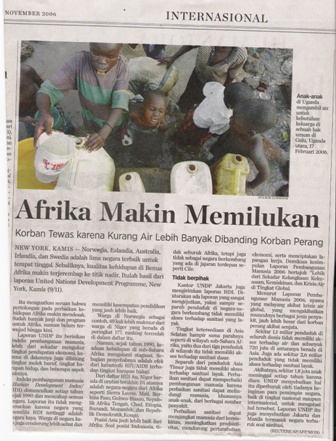
1,1 billion people has no access to clean water, 720 millions in Asia.
1,8 million children died due to diarrhoea.
(Kompas Newspaper, Friday, 10 November 2006, page 11)
Thursday, November 02, 2006

Tuesday, October 31, 2006
Dr. Mardani from Meulaboh, West Aceh
 Dear Friends,
We deeply thank to all of you for your kind support to Mr. Mardani --one of our Aceh Medical Student in Bandung who got your support. Dr. Mardani just graduated from Padjadjaran University, Bandung Medical School in August 2006. Congratulation!
His father and mother killed by tsunami, 26 December 2004 in Meulaboh, West Aceh. He is going to go Meulaboh next Monday, November 5, 2006. He will dedicate his life for helping Aceh people as a medical doctor in Aceh.
He is planning to work in Aceh and temporarily he will work in Permata Hati Hospital before he gets permanent post in Puskesmas (Primary Health Care) or other appointed post, depends on Ministry of Health appointment. I just made phone call with Dr. Marzuki in Banda Aceh, Dr. Marzuki welcomes Dr. Dani to work in Permata Hati Hospital.
This evening, October 31, 2006, he visited me in my house in Bandung and I took his picture. Mardani was born in Meulaboh, West Aceh, June 12, 1980. In January 2005, he served as logistics volunteer for National TV Station that took documentary film of earthquake and tsunami victims in his hometown, Meulaboh, to be aired to all over the world. As a hobby, he masters Capuera Brazilian martial art.
Thank you for your kind support.
With warm regards,
Kadar
Monday, October 23, 2006
Tuesday, October 17, 2006
Yunus: Nobel Peace Prize 2006
THE GOOD BANKER
Alan Jolis
In The Independent on Sunday Supplement, 5 May 1996
Muhammad Yunus believes that he can eradicate world poverty, all by the use of one simple idea. Now the world's leaders are starting to take him seriously. Cynics roll their eyes to the ceiling, but Muhammad Yunus, a 56-year-old banker from Bangladesh, is that rare thing: a bona fide visionary. His dream, which he is actively pursuing, is the total eradication of poverty from the world. "One day," he says confidently, "our grandchildren will go to museums to see what poverty was like." But what is truly amazing about Yunus is not the extravagance of his vision but the fact that, after two decades of working in anonymity, his ideas are winning converts among the world's top policy-makers. Bill Clinton said in his last election campaign that Yunus deserved a Nobel Peace Prize and cited his experiment in Bangladesh as a model for rebuilding the inner cities of America. Since then, the World Bank has made him the head of its advfsory committee to propagate his vision worldwide. He has also won countless prizes and accolades: hailed by "Asia Week" magazine as one of the 25 most influential Asians, by the "New York Times" as the star of the UN's Women's Conference last year, and by ABC TV as Man of the Week. When he's not busy receiving prizes -- the World Food Prize and the Care Humanitarian Award among them -- he is escorting Hillary Clinton on a field trip to his borrowers or preparing for a visit by Queen Sofia of Spain. In July he will come to England to receive an honorary doctorate from Warwick University. What this man has invented that excites so much interest is something called micro-credit. It is both terribly simple and, in the field of development and aid, completely revolutionary. Rather than donating billions to help large infrastructure ventures, Yunus gives loans of as little as A320 to the destitute. A typical borrower from his bank would be a Bangladeshi woman (94 per cent of the bank's borrowers are women) who has never touched money before; all her life, her father and husband will have told her she is useless and a burden to the family; finally, widowed or divorced, she will have been forced to beg to feed her children. Yunus lends her money -- and doesn't regret it. Kept on the straight and narrow by a mixture of peer pressure and peer support, she uses the loan to buy an asset which can immediately start paying income -- such as cotton to weave, or raw materials for bangles or a cow she can milk. She repays the loan in tiny weekly instalments until she becomes self-sufficient. Then, if she wants, she can take out a new, larger loan. Either way, she is no longer poor. His bank provides no training, no education, no infrastructure for its clients. "I firmly believe that all human beings have an innate skill," says Yunus. "I call it the survival skill. The fact that the poor are alive is proof of their ability. We do not need to teach them how to survive: They know this already. Giving the poor credit allows them to put into practice the skills they already know. And the cash they earn is then a tool, a key that unlocks a host of other problems." The Grameen Bank ("rural bank" in Bengali), which Yunus has built over the last 20 years, is today the largest rural banbk in Bangladesh. It has over 2 million borrowers and works in 35,000 villages throughout the country. Assuming that each borrower has six dependents, it is possible that 10 per cent of the population of Bangladesh (or 12 million people) now live directly from the benefit of Grameen loans. By 1994, the bank had lent a total of A3650m; in 1995, it made loans of A3250m. By 1998, it plans to increase its lending to A3650m a year. The bank actively seeks out the most deprived in Bangladeshi society: beggars, illiterates, widows. Yet it claims a loan repayment rate of 99 per cent. Most western banks would be delighted with such a bad debt ratio. And, since 92 per cent of its shares are owned by the borrowers themselves (the balance is owned by the government), it truly is a bank for, and of, the poor. Each borrower is issued with one non-tradeable share and has to start a saving scheme as a form of insurance against disaster. "What Yunus has achieved is simply brilliant," says Bruno Lefevre, who just completed a study of Grameen for UNESCO. The man whose vision has made this all possible is a soft-spoken, bespectacled ex-professor, who lives and dresses simply -- he earns only A3160 a month and is, in public, unassuming and shy. In private Muhammad Yunus is funny, charming and approachable. His best work is done in a two-bedroom apartment at the bank's headquarters in Bangladesh's capital, Dhaka, where he lives with his wife and 10-year-old daughter, Deena. He does not own a car, and, although he was recently persuaded to get a credit card for hotel bookings, he has never actually charged anything to it. Yunus was born in 1940 in Chittagong, the business centre of what was then Eastem Bengal. His father, a goldsmith, did well for himself and pushed his sons to seek higher education. But his main influence was his mother, Sofia Khatun, who had 14 children, of whom five died in childbirth. "Mother always helped any poor who knocked on our door," he explains. "Thanks to her I always knew I would have a mission in life, though I didn't know what form it would take." Tragically, a congenital illness reduced her mental abilities in later life. In 1965, he was awarded a Fulbright scholarship and went to do a PhD at Vanderbilt University in Nashville, Tennessee, where he stayed for seven years. Returning in 1972 to become the head of the economics department at Chittagong University, he found the situation in newly independent Bangladesh worsening day by day. Tbc terrible man-made famine of 1974, which by some estimates killed 1.5 million Bangladeshis, changed his life for ever. "While people were dying of hunger on the streets, I was teaching elegant theories of economics. I started hating myself for the arrogance of pretending I had answers. We university professors were all so intelligent, but we knew absolutely nothing about the poverty surrounding us. Why did people who worked 12 hours a day, seven days a week, not have enough food to eat? I decided that the poor themselves would be my teachers. I began to study them and question them on their lives." Yunus spent most of 1975 and 1976 leading his students on field trips to the nearby village of Jobra. It was easy to see the problem, but what was the solution? He introduced improved rice-farming techniques and established a farmers' cooperative to irrigate during the dry season. Soon he realised that targeting farmers was not helping the truly destitute underclass -- the landless, assetless, rural poor. Then he made his big discovery. One day, interviewing a woman who made bamboo stools, he learnt that, because she had no capital of her own, she had to borrow the equivalent of 15p to buy raw bamboo for each stool made. After repaying the middleman, she kept only a lp profit margin. With the help of his graduate students, he discovered 42 other villagers in the same predicament. "Their poverty was not a personal problem due to laziness or lack of intelligence, but a structural one: lack of capital. The existing system made it certain that the poor could not save a penny and could not invest in bettering themselves. Some money-lenders set interest rates as high as 10 per cent a month, some 10 per cent a week. So, no matter how hard these people worked, they would never raise themselves above subsistence level. What was needed was to link their work to capital to allow them to amass an economic cushion and earn a ready income." And so the idea of credit for the landless was born. Yunus's first approach was to reach into his pocket and lend each of the 42 women the equivalent of A317. He set no interest rate and no repayment date: "I didn't think of myself as a banker, but as the liberator of 42 families." Immediately, Yunus saw the impracticality of carrying on in this way, and tried to interest banks in institutionalising his gesture by lending to the poorest, with no collateral -- Bankers laughed at him, insisting that the poor are not "creditworthy". Yunus answered, "How do you know they are not creditworthy, if you've never tried? Perhaps it is the banks that are not people-worthy?" Undeterred, he started an experimental project in Jobra, the village he and his students had been studying, and staffed it with his graduate students. Between 1976 and 1979, his microloans successfully changed the lives of around 500 borrowers. But it was hard work combining the project with his full-time job as a Professor, and he continued to lobby the state-owned Central Bank and the commercial banks to adopt his experiment. In 1979, the Central Bank was won over and arranged for the Grameen project, as it was then called, to be run from the branches of seven state-run banks -- initially in one province, and, by 1981, in five. Each expansion confirmed the effectivenesss of micro-credit: by 1983, Grameen had 59,000 clients in 86 branches. Eventually, Yunus decided to quit academia and go it alone. Grameen was incorporated as a separate legal institution in 1983, and since then it has moved fast -- some would say too fast -- to expand its operations.
------------------------------------------------------------------------
Grameen is not noticeably "bank-like". It does lend money, and it does get repaid with interest. But there are no telephones in its branches, no typewriters or carpets -- most borrowers are visited by Yunus's staff in their villages -- and no loan agreements. Borrowers who are not destitute are excluded, and so, usually, are men. Yunus soon discovered that lending to women, who traditionally have the least economic opportunity in Bangladeshi society, was much more beneficial to whole families; and that women were more careful about their debts. All that an assetless and landless person must do in order to be eligible for a loan is to prove that they understand how Grameen works. Over the years, representatives of the borrower-shareholders have agreed with the bank certain principles and commitments which they will undertake to help improve their lives and their ability to meet their debts. To Westerners these may seem at best paternalistic; however, the slogans are chanted enthusiastically by the microborrowers. They pledge to abide by "the 16 decisions", a set of personal commitments such as "We pledge to send our children to school," and "We pledge not to demand or pay dowry for our daughters' marriage." The most important of these commitments is to join up with four fellow borrowers, none of whom can be a family member, to form a "group". The group dynamic provides a borrower with the self-discipline and courage needed to enter into these uncharted waters. Peer pressure and peer support effectively replace collateral: if one borrower defaults the whole group is penalised. The system also saves the bank the costly business of screening and monitoring borrowers. Transactions are kept simple. Loans are always for a year and interest is fixed at 20 per cent simple interest, not compounded. Repayment starts the second week of the loan which, though it may sound punishing, releases the borrower from the need to produce a lump sum at the end of the year -- and typically builds her confidence. All loan disbursements and repayments are made publicly in "centre meetings" (in front of eight or 10 groups) on a weekly basis. in a country steeped in corruption at all levels of administration, Grameen prides itself on being as transparent and open as possible.
------------------------------------------------------------------------
Hajeera Begum was born in 1959, in a village not far from Dhaka. Her father, a farm labourer, could not feed his six daughters, and he married her off to a blind man simply because he demanded no dowry. Hajeera and her husband survived on what little she earned cleaning houses, but she was unable to feed her three children regularly. One day she asked her husband for permission to join Grameen, but he had heard it was a Christian front organisation bent on destroying Islam. He threatened to divorce her if she joined. Without telling anyone, she travelled to a nearby village and attended some introductory sessions where Grameen workers explained the principles of the bank. The first time the members of the group she had joined took the oral exam to show they knew the rules of Grameen, Hajeera was so nervous that she couldn't answer the questions. "All my life I was told I was no good. I was told I brought only misery to my parents because I was a woman and my family could not pay for my dowry. Many times I heard my mother say she should have killed me at birth. I did not feel I was worthy of a loan, or that I could ever repay it." She would have given up, but the other members of her group encouraged her, and she passed the exam. At last the day came when she mustered the strength to ask for a loan of 2,000 thaka ( A335). When she received it, tears ran down her face. Her group persuaded her to use the loan to buy a calf for fattening and a share of the rice harvest to process and sell. When her father brought the calf to the house, her husband was so excited that he forgot his threat of divorcing. Within a year Hajeera had paid off her first loan, taken a second loan and used it to rent a piece of land, planted it with 70 banana seedlings, and used the balance to buy a second calf. Today, with a mortgage, she owns a rice field, and goats, ducks and chickens. "We now enjoy three meals a day," says Hajeera. "We can even afford some meat once a week. I intend to send all three of my children to school and college, even university. You ask what I think of Grameen? Grameen is like my mother. She has given me new life."
------------------------------------------------------------------------
Independent studies by the World Bank and others indicate that within five years, about half Grameen's 2 million borrowers manage to pull themselves up over the poverty line, while a further quarter hover near the line. In addition, studies of the Grameen method suggest that after a wife joins the bank, her husband is likely to show her more tenderness and respect. Divorce rates drop among Grameen borrowers, as do birth rates. Why does micro-credit work? What theoretical framework does it rely on? Yunus avoids jargon and graphs; instead, he states simply: "Poverty covers people in a thick crust and makes the poor appear stupid and without initiative. Yet if you give them credit, they will slowly come back to life. Even those who seemingly have no conceptual thought, no ability to think of yesterday or tomorrow, are in fact quite intelligent and expert at the art of survival. Credit is the key that unlocks their humanity." That is not to say that micro-credit solves all problems. One quarter of Grameen borrowers do not manage to repay their loans and remain trapped in poverty, often -- like the woman I met recently who had been featured four years ago on an American television programme as a "Grameen success story " -- because they are too sick or infirm. It is this 25 per cent which is now giving Yunus the most worry; often, he believes, problems arise from the lack of social infrastructure. Meanwhile, critics of Grameen abound. The most vocal are the fundamentalists who believe the bank is anti-Islamic. These conservatives regularly spread wild rumours about Grameen: Hajeera Begum's blind husband was told that if she joined Grameen she would secretly be forced to abandon her faith. I also heard of women being told that Grameen would turn them into Christians and feed them to the tigers; or that they would be tortured, tattooed on the arm and sold into prostitution. One woman was beaten repeatedly by her family to prevent her from joining in 1987, while in 1994, in the conservative north-west of the country, a branch of Grameen was burnt down. Yunus denies that he is in an undeclared war with Islam. Indeed, Grameen claims to be more Islamic than ordinary banks, because it builds up self-employment, instead of forcing women to seek factory jobs away from their families. Furthermore, it does not violate lslam's ban on charging interest because its borrowers own the bank, so that in essence they are paying interest to themselves. When opponents try to prevent Grameen from entering a village, his staff have orders to remain outside, avoiding confrontation, and wait for the women to come to them. Another frequent criticism is that Grameen charges too much interest initially 16 per cent and for the last four years 20 per cent. Yunus's answer is simple: if anyone can run a bank for the poor and charge less, please go ahead and do so. He has promised to reduce interest rates if and when he can. This is significant, because in l995, for the first time in its existence, Grameen finally made enough profit to operate on a fully commercial basis without the need for any more preferential loans (which it has received in the past from Bangladesh's Central Bank and sympathetic banks in the West), or grants from charitable trusts such as the Ford Foundation. Yunus also intends to pay cash dividends to his borrowers. Within the international development community, many people working in traditional aid agencies distrust Yunus's self-help philosophy. They argue that what keeps poor people trapped is inadequate social and welfare policies. It isn't micro-loans that are going to bring water, sanitation, health care and schools to desperate communities. The success of microcredit is distracting governments from their responsibilities, they say. Even those who generally approve of him sometimes ask why Yunus's programme needs to be profit-making at all. Yunus answers this last point with the observation that any institution for the poor that is not self-sufficient is bound to be hurt by reliance on donors: "It is like telling a patient that he can breathe by himself for 23 hours a day, and the balance of the time the govemment will provide the oxygen. That means you are at their mercy. Any time a politician changes his mind, or a bureaucrat forgets, you die." Many aid programmes, he says, are just trying to make poverty tolerable rather than to eliminate it. Despite the opposition, Yunus's method is gathering supporters. Grameen is being copied in 52 countries. The methods are adapted to suit local conditions, but the solution of creating a counter-culture that empowers individuals with their own capital is the same. The United States alone has over 500 Grameen spin-offs. Englewood is a murderous crack-ridden ghetto on the south side of.Chicago, where you would never imagine a Bengali professor would have any role to play. But the Full Circle Fund, a Grameen clone created by the city's South Shore Bank, has operated there for 10 years. Here the borrowers are mostly welfare mothers: they take out loans of as little as $375 ( A3250) to buy nail-sculpting boxes; they start beauty salons, make and sell jewellery, open bookstores, create daycare centres and rehabilitate buildings. In Chicago dowries are not an issue but, as part of joining FCF, borrowers pledge not to waste money on expensive funerals.
------------------------------------------------------------------------
The bank has entered into an arreement with the Governor of Illinois so that borrowers can continue to receive welfare benefits in the transitional period until they become self-reliant. To see women weep for joy when they inform the authorities that they no longer need welfare is a moving experience. Group solidarity works well in America's black ghettos, on Indian reservations, in rural Arkansas -- wherever the social life of the poor is tightly knit. But in many urban settings in the West the lack of it has been the greatest stumbling block to the Grameen method. Maria Nowak, a worker for the World Bank who has set up Grameen replicas in Albania and in Bosnia, has not had the same success in France, where she is based. "Ther e is simply no solidarity among the poorest of the poor here," she says. "Why would a Zairean tortured in prison in her country and now living in Paris care about a fellow borrower living in a train station out of garbage bags? There is not enough social fabric left on which to hook the group solidarity." But even replicators in Asia and Africa report that it is more difficult to make microcredit work in urban areas, especially among those who have no fixed address and thus few links to their neighbours. Yunus does not pretend to have solution for all problems. What he does say ts that by creating wealth in the countryside, Grameen can reduce the pressure on those moving to the urban slums. He also points to the success of the newly formed Shokhti Foundation, which has 118,000 micro-loan borrowers in the shanty towns of Dhaka; and to the Self Employed Women's Association (SEWA), which has many more in Indian cities. It has also been suggested that microcredit cannot flourish in Westem countries without Bangladesh's long history of self-employment. But Yunus believes that self-employment is the future. He has visited China, where Grameen loans have helped starving peasants who have too little to keep warm in winter; he has travelled to South Africa and met with the poor who jump at the chance to start their own car repair workshop or timber-sawing business, or plant wheat. All this has convinced him that, as Jan Piercy, US Executive Director of the World Bank, puts it: "Creating jobs requires huge investment, management, overheads ... It is extremely complex and time-consuming to set up, whereas self-employment is inunediate. It may be tiny, but each tiny bit contributed by the millions adds up."
------------------------------------------------------------------------
It is Yunus's very pragmatism, and his refusal to be cornered by ideology, which his supporters say may prevent him from getting the Nobel Prize for economics -- which usually rewards theoretical work. But Yunus is far too ambitious for Grameen to worry about a mere prize. What he has set his sights on is the total eradication of poverty from the world and to hear him discuss it is spine-tingling: "There are 1.2 billon poor in the world. Grameen has reached 2 million of them, our copycats service another 1.5 million in Bangladesh. Our international replicators have 2.5 million borrowers. That means so far, counting dependants, we've helped 36 million. If we can reach 100 million, that will be a critical mass. The rest will be easy. "People say I am crazy, but no one can achieve anything without a dream. When you build a house, you can't just assemble a bunch of bricks and mortar, you must first have the idea that it can be done. If one is going to make headway against poverty, one cannot do business as usual. One must be revolutionary and think the unthinkable."
Alan Jolis
In The Independent on Sunday Supplement, 5 May 1996
Muhammad Yunus believes that he can eradicate world poverty, all by the use of one simple idea. Now the world's leaders are starting to take him seriously. Cynics roll their eyes to the ceiling, but Muhammad Yunus, a 56-year-old banker from Bangladesh, is that rare thing: a bona fide visionary. His dream, which he is actively pursuing, is the total eradication of poverty from the world. "One day," he says confidently, "our grandchildren will go to museums to see what poverty was like." But what is truly amazing about Yunus is not the extravagance of his vision but the fact that, after two decades of working in anonymity, his ideas are winning converts among the world's top policy-makers. Bill Clinton said in his last election campaign that Yunus deserved a Nobel Peace Prize and cited his experiment in Bangladesh as a model for rebuilding the inner cities of America. Since then, the World Bank has made him the head of its advfsory committee to propagate his vision worldwide. He has also won countless prizes and accolades: hailed by "Asia Week" magazine as one of the 25 most influential Asians, by the "New York Times" as the star of the UN's Women's Conference last year, and by ABC TV as Man of the Week. When he's not busy receiving prizes -- the World Food Prize and the Care Humanitarian Award among them -- he is escorting Hillary Clinton on a field trip to his borrowers or preparing for a visit by Queen Sofia of Spain. In July he will come to England to receive an honorary doctorate from Warwick University. What this man has invented that excites so much interest is something called micro-credit. It is both terribly simple and, in the field of development and aid, completely revolutionary. Rather than donating billions to help large infrastructure ventures, Yunus gives loans of as little as A320 to the destitute. A typical borrower from his bank would be a Bangladeshi woman (94 per cent of the bank's borrowers are women) who has never touched money before; all her life, her father and husband will have told her she is useless and a burden to the family; finally, widowed or divorced, she will have been forced to beg to feed her children. Yunus lends her money -- and doesn't regret it. Kept on the straight and narrow by a mixture of peer pressure and peer support, she uses the loan to buy an asset which can immediately start paying income -- such as cotton to weave, or raw materials for bangles or a cow she can milk. She repays the loan in tiny weekly instalments until she becomes self-sufficient. Then, if she wants, she can take out a new, larger loan. Either way, she is no longer poor. His bank provides no training, no education, no infrastructure for its clients. "I firmly believe that all human beings have an innate skill," says Yunus. "I call it the survival skill. The fact that the poor are alive is proof of their ability. We do not need to teach them how to survive: They know this already. Giving the poor credit allows them to put into practice the skills they already know. And the cash they earn is then a tool, a key that unlocks a host of other problems." The Grameen Bank ("rural bank" in Bengali), which Yunus has built over the last 20 years, is today the largest rural banbk in Bangladesh. It has over 2 million borrowers and works in 35,000 villages throughout the country. Assuming that each borrower has six dependents, it is possible that 10 per cent of the population of Bangladesh (or 12 million people) now live directly from the benefit of Grameen loans. By 1994, the bank had lent a total of A3650m; in 1995, it made loans of A3250m. By 1998, it plans to increase its lending to A3650m a year. The bank actively seeks out the most deprived in Bangladeshi society: beggars, illiterates, widows. Yet it claims a loan repayment rate of 99 per cent. Most western banks would be delighted with such a bad debt ratio. And, since 92 per cent of its shares are owned by the borrowers themselves (the balance is owned by the government), it truly is a bank for, and of, the poor. Each borrower is issued with one non-tradeable share and has to start a saving scheme as a form of insurance against disaster. "What Yunus has achieved is simply brilliant," says Bruno Lefevre, who just completed a study of Grameen for UNESCO. The man whose vision has made this all possible is a soft-spoken, bespectacled ex-professor, who lives and dresses simply -- he earns only A3160 a month and is, in public, unassuming and shy. In private Muhammad Yunus is funny, charming and approachable. His best work is done in a two-bedroom apartment at the bank's headquarters in Bangladesh's capital, Dhaka, where he lives with his wife and 10-year-old daughter, Deena. He does not own a car, and, although he was recently persuaded to get a credit card for hotel bookings, he has never actually charged anything to it. Yunus was born in 1940 in Chittagong, the business centre of what was then Eastem Bengal. His father, a goldsmith, did well for himself and pushed his sons to seek higher education. But his main influence was his mother, Sofia Khatun, who had 14 children, of whom five died in childbirth. "Mother always helped any poor who knocked on our door," he explains. "Thanks to her I always knew I would have a mission in life, though I didn't know what form it would take." Tragically, a congenital illness reduced her mental abilities in later life. In 1965, he was awarded a Fulbright scholarship and went to do a PhD at Vanderbilt University in Nashville, Tennessee, where he stayed for seven years. Returning in 1972 to become the head of the economics department at Chittagong University, he found the situation in newly independent Bangladesh worsening day by day. Tbc terrible man-made famine of 1974, which by some estimates killed 1.5 million Bangladeshis, changed his life for ever. "While people were dying of hunger on the streets, I was teaching elegant theories of economics. I started hating myself for the arrogance of pretending I had answers. We university professors were all so intelligent, but we knew absolutely nothing about the poverty surrounding us. Why did people who worked 12 hours a day, seven days a week, not have enough food to eat? I decided that the poor themselves would be my teachers. I began to study them and question them on their lives." Yunus spent most of 1975 and 1976 leading his students on field trips to the nearby village of Jobra. It was easy to see the problem, but what was the solution? He introduced improved rice-farming techniques and established a farmers' cooperative to irrigate during the dry season. Soon he realised that targeting farmers was not helping the truly destitute underclass -- the landless, assetless, rural poor. Then he made his big discovery. One day, interviewing a woman who made bamboo stools, he learnt that, because she had no capital of her own, she had to borrow the equivalent of 15p to buy raw bamboo for each stool made. After repaying the middleman, she kept only a lp profit margin. With the help of his graduate students, he discovered 42 other villagers in the same predicament. "Their poverty was not a personal problem due to laziness or lack of intelligence, but a structural one: lack of capital. The existing system made it certain that the poor could not save a penny and could not invest in bettering themselves. Some money-lenders set interest rates as high as 10 per cent a month, some 10 per cent a week. So, no matter how hard these people worked, they would never raise themselves above subsistence level. What was needed was to link their work to capital to allow them to amass an economic cushion and earn a ready income." And so the idea of credit for the landless was born. Yunus's first approach was to reach into his pocket and lend each of the 42 women the equivalent of A317. He set no interest rate and no repayment date: "I didn't think of myself as a banker, but as the liberator of 42 families." Immediately, Yunus saw the impracticality of carrying on in this way, and tried to interest banks in institutionalising his gesture by lending to the poorest, with no collateral -- Bankers laughed at him, insisting that the poor are not "creditworthy". Yunus answered, "How do you know they are not creditworthy, if you've never tried? Perhaps it is the banks that are not people-worthy?" Undeterred, he started an experimental project in Jobra, the village he and his students had been studying, and staffed it with his graduate students. Between 1976 and 1979, his microloans successfully changed the lives of around 500 borrowers. But it was hard work combining the project with his full-time job as a Professor, and he continued to lobby the state-owned Central Bank and the commercial banks to adopt his experiment. In 1979, the Central Bank was won over and arranged for the Grameen project, as it was then called, to be run from the branches of seven state-run banks -- initially in one province, and, by 1981, in five. Each expansion confirmed the effectivenesss of micro-credit: by 1983, Grameen had 59,000 clients in 86 branches. Eventually, Yunus decided to quit academia and go it alone. Grameen was incorporated as a separate legal institution in 1983, and since then it has moved fast -- some would say too fast -- to expand its operations.
------------------------------------------------------------------------
Grameen is not noticeably "bank-like". It does lend money, and it does get repaid with interest. But there are no telephones in its branches, no typewriters or carpets -- most borrowers are visited by Yunus's staff in their villages -- and no loan agreements. Borrowers who are not destitute are excluded, and so, usually, are men. Yunus soon discovered that lending to women, who traditionally have the least economic opportunity in Bangladeshi society, was much more beneficial to whole families; and that women were more careful about their debts. All that an assetless and landless person must do in order to be eligible for a loan is to prove that they understand how Grameen works. Over the years, representatives of the borrower-shareholders have agreed with the bank certain principles and commitments which they will undertake to help improve their lives and their ability to meet their debts. To Westerners these may seem at best paternalistic; however, the slogans are chanted enthusiastically by the microborrowers. They pledge to abide by "the 16 decisions", a set of personal commitments such as "We pledge to send our children to school," and "We pledge not to demand or pay dowry for our daughters' marriage." The most important of these commitments is to join up with four fellow borrowers, none of whom can be a family member, to form a "group". The group dynamic provides a borrower with the self-discipline and courage needed to enter into these uncharted waters. Peer pressure and peer support effectively replace collateral: if one borrower defaults the whole group is penalised. The system also saves the bank the costly business of screening and monitoring borrowers. Transactions are kept simple. Loans are always for a year and interest is fixed at 20 per cent simple interest, not compounded. Repayment starts the second week of the loan which, though it may sound punishing, releases the borrower from the need to produce a lump sum at the end of the year -- and typically builds her confidence. All loan disbursements and repayments are made publicly in "centre meetings" (in front of eight or 10 groups) on a weekly basis. in a country steeped in corruption at all levels of administration, Grameen prides itself on being as transparent and open as possible.
------------------------------------------------------------------------
Hajeera Begum was born in 1959, in a village not far from Dhaka. Her father, a farm labourer, could not feed his six daughters, and he married her off to a blind man simply because he demanded no dowry. Hajeera and her husband survived on what little she earned cleaning houses, but she was unable to feed her three children regularly. One day she asked her husband for permission to join Grameen, but he had heard it was a Christian front organisation bent on destroying Islam. He threatened to divorce her if she joined. Without telling anyone, she travelled to a nearby village and attended some introductory sessions where Grameen workers explained the principles of the bank. The first time the members of the group she had joined took the oral exam to show they knew the rules of Grameen, Hajeera was so nervous that she couldn't answer the questions. "All my life I was told I was no good. I was told I brought only misery to my parents because I was a woman and my family could not pay for my dowry. Many times I heard my mother say she should have killed me at birth. I did not feel I was worthy of a loan, or that I could ever repay it." She would have given up, but the other members of her group encouraged her, and she passed the exam. At last the day came when she mustered the strength to ask for a loan of 2,000 thaka ( A335). When she received it, tears ran down her face. Her group persuaded her to use the loan to buy a calf for fattening and a share of the rice harvest to process and sell. When her father brought the calf to the house, her husband was so excited that he forgot his threat of divorcing. Within a year Hajeera had paid off her first loan, taken a second loan and used it to rent a piece of land, planted it with 70 banana seedlings, and used the balance to buy a second calf. Today, with a mortgage, she owns a rice field, and goats, ducks and chickens. "We now enjoy three meals a day," says Hajeera. "We can even afford some meat once a week. I intend to send all three of my children to school and college, even university. You ask what I think of Grameen? Grameen is like my mother. She has given me new life."
------------------------------------------------------------------------
Independent studies by the World Bank and others indicate that within five years, about half Grameen's 2 million borrowers manage to pull themselves up over the poverty line, while a further quarter hover near the line. In addition, studies of the Grameen method suggest that after a wife joins the bank, her husband is likely to show her more tenderness and respect. Divorce rates drop among Grameen borrowers, as do birth rates. Why does micro-credit work? What theoretical framework does it rely on? Yunus avoids jargon and graphs; instead, he states simply: "Poverty covers people in a thick crust and makes the poor appear stupid and without initiative. Yet if you give them credit, they will slowly come back to life. Even those who seemingly have no conceptual thought, no ability to think of yesterday or tomorrow, are in fact quite intelligent and expert at the art of survival. Credit is the key that unlocks their humanity." That is not to say that micro-credit solves all problems. One quarter of Grameen borrowers do not manage to repay their loans and remain trapped in poverty, often -- like the woman I met recently who had been featured four years ago on an American television programme as a "Grameen success story " -- because they are too sick or infirm. It is this 25 per cent which is now giving Yunus the most worry; often, he believes, problems arise from the lack of social infrastructure. Meanwhile, critics of Grameen abound. The most vocal are the fundamentalists who believe the bank is anti-Islamic. These conservatives regularly spread wild rumours about Grameen: Hajeera Begum's blind husband was told that if she joined Grameen she would secretly be forced to abandon her faith. I also heard of women being told that Grameen would turn them into Christians and feed them to the tigers; or that they would be tortured, tattooed on the arm and sold into prostitution. One woman was beaten repeatedly by her family to prevent her from joining in 1987, while in 1994, in the conservative north-west of the country, a branch of Grameen was burnt down. Yunus denies that he is in an undeclared war with Islam. Indeed, Grameen claims to be more Islamic than ordinary banks, because it builds up self-employment, instead of forcing women to seek factory jobs away from their families. Furthermore, it does not violate lslam's ban on charging interest because its borrowers own the bank, so that in essence they are paying interest to themselves. When opponents try to prevent Grameen from entering a village, his staff have orders to remain outside, avoiding confrontation, and wait for the women to come to them. Another frequent criticism is that Grameen charges too much interest initially 16 per cent and for the last four years 20 per cent. Yunus's answer is simple: if anyone can run a bank for the poor and charge less, please go ahead and do so. He has promised to reduce interest rates if and when he can. This is significant, because in l995, for the first time in its existence, Grameen finally made enough profit to operate on a fully commercial basis without the need for any more preferential loans (which it has received in the past from Bangladesh's Central Bank and sympathetic banks in the West), or grants from charitable trusts such as the Ford Foundation. Yunus also intends to pay cash dividends to his borrowers. Within the international development community, many people working in traditional aid agencies distrust Yunus's self-help philosophy. They argue that what keeps poor people trapped is inadequate social and welfare policies. It isn't micro-loans that are going to bring water, sanitation, health care and schools to desperate communities. The success of microcredit is distracting governments from their responsibilities, they say. Even those who generally approve of him sometimes ask why Yunus's programme needs to be profit-making at all. Yunus answers this last point with the observation that any institution for the poor that is not self-sufficient is bound to be hurt by reliance on donors: "It is like telling a patient that he can breathe by himself for 23 hours a day, and the balance of the time the govemment will provide the oxygen. That means you are at their mercy. Any time a politician changes his mind, or a bureaucrat forgets, you die." Many aid programmes, he says, are just trying to make poverty tolerable rather than to eliminate it. Despite the opposition, Yunus's method is gathering supporters. Grameen is being copied in 52 countries. The methods are adapted to suit local conditions, but the solution of creating a counter-culture that empowers individuals with their own capital is the same. The United States alone has over 500 Grameen spin-offs. Englewood is a murderous crack-ridden ghetto on the south side of.Chicago, where you would never imagine a Bengali professor would have any role to play. But the Full Circle Fund, a Grameen clone created by the city's South Shore Bank, has operated there for 10 years. Here the borrowers are mostly welfare mothers: they take out loans of as little as $375 ( A3250) to buy nail-sculpting boxes; they start beauty salons, make and sell jewellery, open bookstores, create daycare centres and rehabilitate buildings. In Chicago dowries are not an issue but, as part of joining FCF, borrowers pledge not to waste money on expensive funerals.
------------------------------------------------------------------------
The bank has entered into an arreement with the Governor of Illinois so that borrowers can continue to receive welfare benefits in the transitional period until they become self-reliant. To see women weep for joy when they inform the authorities that they no longer need welfare is a moving experience. Group solidarity works well in America's black ghettos, on Indian reservations, in rural Arkansas -- wherever the social life of the poor is tightly knit. But in many urban settings in the West the lack of it has been the greatest stumbling block to the Grameen method. Maria Nowak, a worker for the World Bank who has set up Grameen replicas in Albania and in Bosnia, has not had the same success in France, where she is based. "Ther e is simply no solidarity among the poorest of the poor here," she says. "Why would a Zairean tortured in prison in her country and now living in Paris care about a fellow borrower living in a train station out of garbage bags? There is not enough social fabric left on which to hook the group solidarity." But even replicators in Asia and Africa report that it is more difficult to make microcredit work in urban areas, especially among those who have no fixed address and thus few links to their neighbours. Yunus does not pretend to have solution for all problems. What he does say ts that by creating wealth in the countryside, Grameen can reduce the pressure on those moving to the urban slums. He also points to the success of the newly formed Shokhti Foundation, which has 118,000 micro-loan borrowers in the shanty towns of Dhaka; and to the Self Employed Women's Association (SEWA), which has many more in Indian cities. It has also been suggested that microcredit cannot flourish in Westem countries without Bangladesh's long history of self-employment. But Yunus believes that self-employment is the future. He has visited China, where Grameen loans have helped starving peasants who have too little to keep warm in winter; he has travelled to South Africa and met with the poor who jump at the chance to start their own car repair workshop or timber-sawing business, or plant wheat. All this has convinced him that, as Jan Piercy, US Executive Director of the World Bank, puts it: "Creating jobs requires huge investment, management, overheads ... It is extremely complex and time-consuming to set up, whereas self-employment is inunediate. It may be tiny, but each tiny bit contributed by the millions adds up."
------------------------------------------------------------------------
It is Yunus's very pragmatism, and his refusal to be cornered by ideology, which his supporters say may prevent him from getting the Nobel Prize for economics -- which usually rewards theoretical work. But Yunus is far too ambitious for Grameen to worry about a mere prize. What he has set his sights on is the total eradication of poverty from the world and to hear him discuss it is spine-tingling: "There are 1.2 billon poor in the world. Grameen has reached 2 million of them, our copycats service another 1.5 million in Bangladesh. Our international replicators have 2.5 million borrowers. That means so far, counting dependants, we've helped 36 million. If we can reach 100 million, that will be a critical mass. The rest will be easy. "People say I am crazy, but no one can achieve anything without a dream. When you build a house, you can't just assemble a bunch of bricks and mortar, you must first have the idea that it can be done. If one is going to make headway against poverty, one cannot do business as usual. One must be revolutionary and think the unthinkable."
Subscribe to:
Posts (Atom)